
WHEN SIMPLE TECH WINS
We’ve all seen it happen: a business tries to fix a process problem by adding another tool. Then another. And another. Suddenly, the team spends more time switching between apps than actually working. According to HP’s 2025 study, knowledge workers now spend over half of their day – 51% – on repetitive or low-value tasks, much of it caused by clunky or disconnected systems. Even worse, 85% say it’s a major reason they feel burned out.
It’s not that people resist technology – it’s that bad technology resists people.
WHEN TECH STARTS SLOWING YOU DOWN
A 2025 survey found that 59% of UK employees would consider leaving a job if the internal systems were too complicated. That’s not just a user-experience issue – that’s a retention crisis. Nearly 40% admit they ignore the software they’re given, either because it’s confusing, irrelevant, or simply not worth the effort.
In hybrid teams, the pain is sharper. Too many apps. Too many notifications. Too much noise. A third of remote workers say switching between tools is their biggest frustration, and 31% blame poor communication on that overload. More isn’t better – it’s just more.
WHY SIMPLICITY WINS EVERY TIME
Here’s the quiet truth: complexity kills momentum.
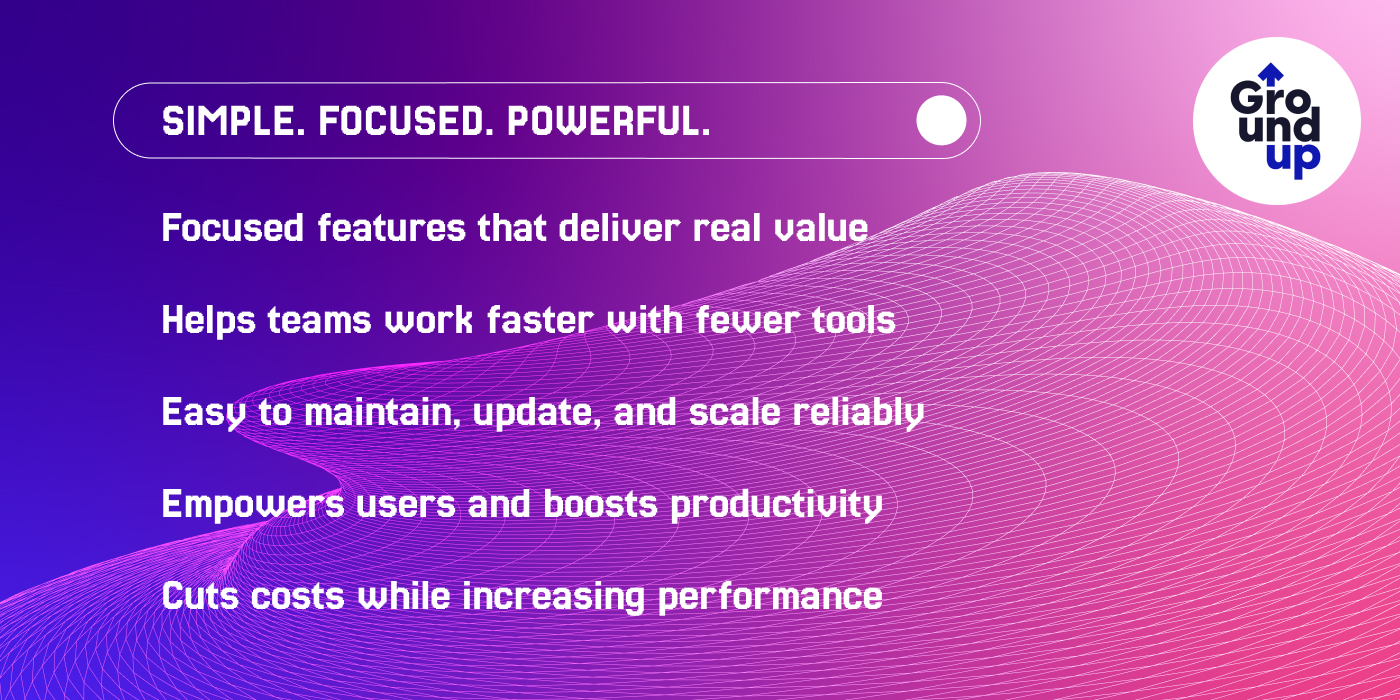
It slows teams down, adds hidden costs, and makes even simple changes risky. Every new feature or integration adds another layer of dependency – another point of failure. Simple tech, on the other hand, does exactly what it needs to do – no more, no less. It’s easier to train, easier to maintain, and easier to love. When systems are intuitive, people stop thinking about how to work and just get things done. That’s where productivity lives – in the absence of friction.
JUST COMPARE

ENGINEERING WITHOUT THE EGO
As developers, we sometimes mistake complexity for craftsmanship. We take pride in elegant abstractions, clever workarounds, and sprawling architectures – until the system becomes so intricate that no one can change it without breaking something. It’s a quiet trap: we build for the sake of brilliance, not the sake of clarity.
McKinsey’s 2024 research highlights the impact of this mindset. Companies that prioritise streamlined, maintainable systems see around 30% higher ROI on their technology investments than those wrestling with fragmented, over-engineered stacks.
Simplicity isn’t laziness; it’s mastery. It’s the confidence to say NO to unnecessary features, to design code that anyone on the team can understand six months later, to focus on reliability before novelty. True engineering excellence is measured not by what you add, but by what you refuse to overcomplicate.
Complexity is seductive – it makes projects look ambitious. But in the real world, simple wins every time. It’s faster to use, easier to grow, and far more sustainable. The future belongs to teams that build technology that disappears — tools that let people focus on the work, not the system.
And that’s exactly what simple tech does.